

Adding Distractions When Dog Training Indoors to Improve Dog Walks

“My dog knows how to walk nicely and respond to my cues inside the house but as soon as we go outside, my dog seems to forget everything.”

“My dog is great in our yard and in dog class but has a lot of trouble on neighbourhood walks where there are so many distractions like rabbits, squirrels, other dogs, cars, and people on bikes.”

“As soon as my dog sees the leash, it’s like my dog’s brain goes offline.”

Practicing skills inside is very different from practicing those same skills outside.

What can you do? When your dog has mastered a skill indoors, begin to add distractions one at a time. Distractions that mimic some of the distractions outside. Distractions that are not the same as the ones outside but that are still exciting. Don’t make it too difficult for your dog. Baby steps. Make sure your dog masters each skill with the distraction before you increase the intensity of the distraction or before you add an additional distraction.

For example, if your dog gets amped up on walks when your dog hears another dog barking, you can try using a recording of the sound of dogs barking during your indoor training sessions. Try to start with barking sounds that seem happy rather than dogs fighting or guarding or in fear. The internet should have videos of dog parks or dogs playing, for example. Start at a very low volume — just loud enough for your dog to barely notice. You might have to start with just a few seconds of the sounds and then turn it off and continue to train without the sound. Then as your dog proves to be able to still perform known skills at an expert level, you can increase the duration of the sounds. Or increase the volume a tiny bit. Eventually, over subsequent training sessions your dog will be able to ignore the barking sound at a normal level for a longer duration.

For dogs who find squirrels very exciting, you can find the sounds of squirrels on the internet. Eventually, when your dog is okay to train indoors with the sounds of squirrels playing at a normal volume, you can try playing a video of a squirrel, if your dog notices images on a monitor/TV screen. Some dogs don’t watch TV, but if your dog does, you can try using this as a way to provide visual distractions. But start without the sound. And you might want to show it for a few seconds. Or dim the screen so that it’s not that easy to see the squirrel. The idea is to start at a very low level distaction — low enough that your dog can succeed. Then progress in very tiny steps when your dog has mastered each step.

The indoor distractions don’t have to be the same as the outdoor distractions

Creating distractions indoors that challenge your dog’s attention don’t have to be the same as those outdoors. The value lies in providing opportunities for your dog to succeed in working around any distraction. Your dog will become better at ignoring distractions in general. If you are wearing a silly hat, if you do some jumping jacks, if you place a toy nearby, if someone in the house is walking in and out of the room, if you place an empty box nearby.

If you start training indoors with your dog wearing the harness used for walking, this can help your dog become less amped up about wearing the harness because it won’t always mean a walk is coming. If you bring out the leash and your dog gets excited, place the leash on the floor and train. If your dog is calm about that and can easily train, you can try holding the leash but not attaching it to your dog’s harness/collar. When your dog finds that easy, you can then attach the leash — maybe for a short time at first. Find the level of difficulty that is a slight challenge for your dog that your dog can succeed at. Practice at that level until mastery and then increase the level of difficulty. This might take several training sessions.

Training Tip: short sessions (1 to 5 minutes) several times a day

Short, frequent training sessions are usually more effective than one long session.

Allow your dog to have mini-breaks (10 seconds? 30 seconds?) during a training session

Learning is hard. It drains the brain. Provide the option for your dog to take mini-breaks during a session. Then, when your dog looks like they want to resume training, resume again. For example, if you are practicing a skill that has repetitions (reps), you can do a set of 3 to 5 reps and then release your dog for a mini-break and walk a few steps away. If your dog looks like they want to keep training, do another set of 3 to 5 reps.

For dogs that become overly amped up by training, you can provide mini-breaks and then when they look like they want to resume, wait for them to show that they are a bit calmer. Perhaps you have trained them to go to their place (a dog bed) and you can use that as a cue that training will resume. Then, once they learn that cue, you can wait for the dog to offer that behaviour on their own. When they can calm themselves and go to their place and wait on their own, you can resume the session and do another set of 3 to 5 reps of whatever you were working on.

Always end the training session BEFORE your dog starts to lose interest or BEFORE your dog starts to drop in performance

Sometimes we want to keep working at it but the dog is “done” mentally, physically, or emotionally. Keep training fun for your dog and your dog will be more likely to want to perform those behaviours in the future. For dogs that get really excited by training, short sessions with mini breaks will help them practice emotional regulation.

End the session with a clear signal that the session has ended. It might be something like “That’s All” or “Finished” and then perhaps toss a few treats on the ground and walk away and put the training equipment away. End the session for real. Don’t be tempted to do another session right away. Let the dog know that when you give the end of session signal, it means the session is over. Non-negotiable. Otherwise, if you resume again, your dog will be likely to keep pestering you to do more training.
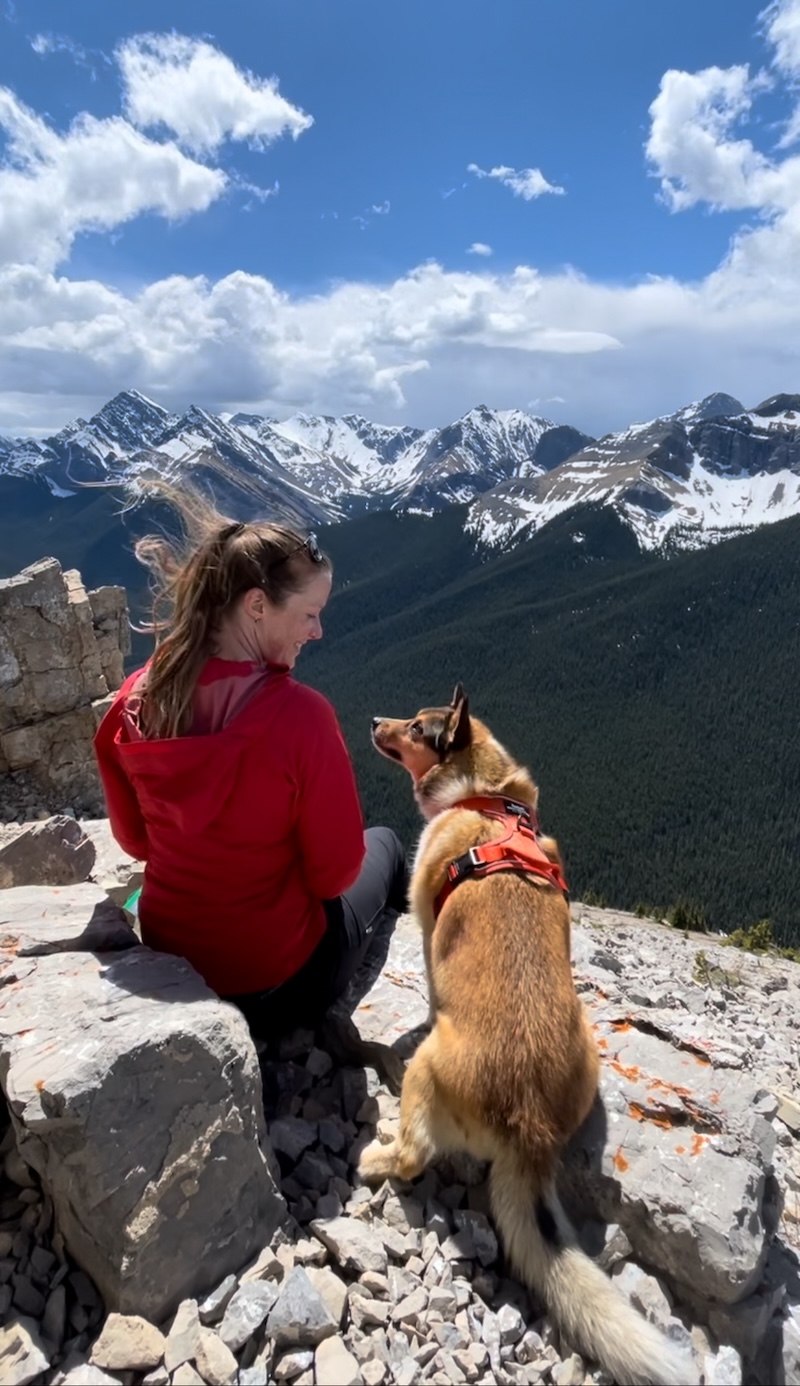
Aversive to Force Free Dog Training: A Conversation with Stephanie Rombough

Woman in red jacket smiling at brown dog; both are sitting on top of cliff with mountains in view.

Stephanie with Neirah, a Corgi/Heeler mix, on a summit hike called Sulphur Skyline in Jasper National Park. (Photo credit Lars Bjornstad)

I’ve interviewed several dog trainers over the years about their decision to move away from aversive methods that use force, pressure, corrections to focus on positive reinforcement methods. Some common experiences of the trainers I interviewed include:

  • their initial underlying motivation to make the change was based on an emotional connection with a dog;
  • knowledgeable instruction and support from skilled positive force-free trainers was important to their success;
  • they faced significant negatively from others, including aversive trainers in their local community and online;
  • they felt unpleasant emotions as they came to terms with the negative experiences of the dogs they trained previously, but this was off-set by how much better they felt training without aversive methods/tools and how much happier their dogs seemed about training.

I’d also like to point out that not one of the trainers I interviewed said that they were unable to train dogs to the same level of proficiency as previously, and some mentioned that once their new dog training skills were developed, the dogs seemed to learn more quickly. This was glaringly apparent in Sue Ailsby’s experience when she tells of teaching her dog to do the broad jump in a matter of minutes using clicker training, while others in her kennel club had been trying for over a year to teach their dogs to do the broad jump using aversive methods. You can read about Sue Ailsby’s crossover journey “Responding to Change: One Trainer’s Journey From Compulsion to Positive Reinforcement” in the Spring 2022 issue of APDT Chronicle of the Dog, pages 44 – 49.

Most recently, I interviewed Stephanie Rombough, a force-free trainer from Edmonton, Canada. You may have seen her dog training videos on social media. Her instructional videos are clear, concise, and easy to implement, and I have several of her videos bookmarked so I can easily share with dog owners looking for help. Stephanie, like myself, had a parent who was a compulsion-based dog trainer and she learned how to train dogs and was a firm believer that dogs needed to be trained this way. Until she met a very special dog named Burrito. You can read the interview in Stephanie’s blog post

As Easy as ABC

Two young children sitting at a wall-mounted easel, drawing on white paper with markers.
Wall-mounted easel (made by Kustom Kitties Canada)

This image illustrates a principle that is true for good teaching: provide the learner with an opportunity to perform a natural behaviour in a context that is preferred.

Young children like to draw on walls. Instead of punishing a child for doing a self-reinforcing behaviour that is very natural, why not create the conditions to help redirect that behaviour to a desirable location? Provide a wall mounted easel, a place to hold art supplies, and a couple of chairs.

This image illustrates the power of using antecedent arrangements to influence behaviour. (Antecedents are the factors that influence a behaviour before it occurs.) To change an undesirable behaviour, good teaching involves understanding what factors are causing the undesirable behaviour and then setting up the environment to encourage a preferred behaviour — a behaviour that can then be reinforced with attention and praise. The new behaviour is more likely to be repeated again, and the old behaviour is less likely to be repeated because it has become less reinforcing.

It’s as easy as ABC (Antecedent — Behaviour — Consequence).

Good Dog Trainers are Good Teachers

Good teaching — whether it’s teaching children, adults, or dogs — starts with A) an understanding of the learner and B) a desire to be kind. Good teaching (and dog training) requires clear communication, creating conditions so the learner can succeed, and being able to support the learner in the learning process. Gone are the days when students were strapped, swatted with rulers, or forced to stand in the corner or wear a dunce cap. Society no longer accepts this type of treatment of students, and years of good science proves how detrimental this is to the learner.

The dog training industry is changing to reflect this as dog training and behaviour professionals are catching up to advancements in teaching excellence. Dogs deserve the best in dog training.

An experiment

I understand that dogs are not children and that there may be some major differences in what people believe is appropriate, ethical, moral, and legal when raising and teaching children as opposed to raising and training dogs. However, it is interesting that if one looks at history, it wasn’t so long ago when there were very few laws protecting children; and if I recall what I read many years ago from a book about the history of animal welfare laws (its title escapes me because it was so long ago), I believe that the first animal welfare law in the USA (to protect horses) was enacted before child welfare laws. And one of the arguments to create child protection laws was the fact that surely there should be at least the similar protections for children as there were for horses.

It’s common to see posts by professional dog trainers who are very vocal about using shock collars, prong collars, etc. and often these trainers are very vocal in their opinions against force-free training/trainers. As an experiment in understanding the mindset of trainers who think differently from me, read a long post by an established and I’m sure very talented trainer. As I read the long post and the comments I couldn’t help but think about how the trainer’s words and the comments by the supportive dog owners might sound if they were used to describe children instead of dogs. Might those who expressed those beliefs about dogs, dog training, and dog trainers change their minds? Would the change reveal underlying biases, leaps in logic, contradictions, and cognitive dissonance of the writers and the readers?

Here is an example of a paragraph I revised. The original was from a trainer who promotes the use of shock/prong/choke collars. The trainer was outraged by the “stories and propaganda” that was being spread about these training collars.

“Leather straps and rattan canes have been the most common recipients of this bad press. And sure, you could definitely mess up a child with either of these tools – if that was your intent – just like you could with any object. But I see far more messed up kids who show up in my school who have parents who refuse to let their child be strapped or spanked.

I acknowledge that the people who expressed these opinions might not hold the same thoughts today — people are allowed to change their minds. We are all doing our best based on the information we have at the time.

I find it interesting to look back at the struggle to get corporal punishment removed from public schools — the resistance and the time it took — and compare it to what is happening in the dog training industry. I suspect that the momentum is building in North America, as it did in Europe years ago.

Training Your Dog to Be Alone

book cover: Teach Your Dog How to Be Alone

This is not like other dog training books

This is a user manual for preventing separation anxiety and for teaching a dog how to be confident enough not to have to follow people from room to room. This is a life-saver for people who wish to be able to have a shower or use the bathroom without the dog having to come along, too. Contact a reputable professional to help dogs with moderate to severe separation anxiety.

“Loved the book. Very straightforward. Can be read in an afternoon. Great practical advice and easy to follow steps.” — Jacqueline Paul Surdu, Regina, SK

“I have been using some tips from your book and working with Odie to go to his crate on his own with great success. This morning I was gathering things to head out the door he just knew and went to his crate without me saying a word. Almost too easy for a pup that is anything but easy“ — Stephanie Bank, Regina, SK

If you are interested in purchasing a printed copy, contact me through email.