
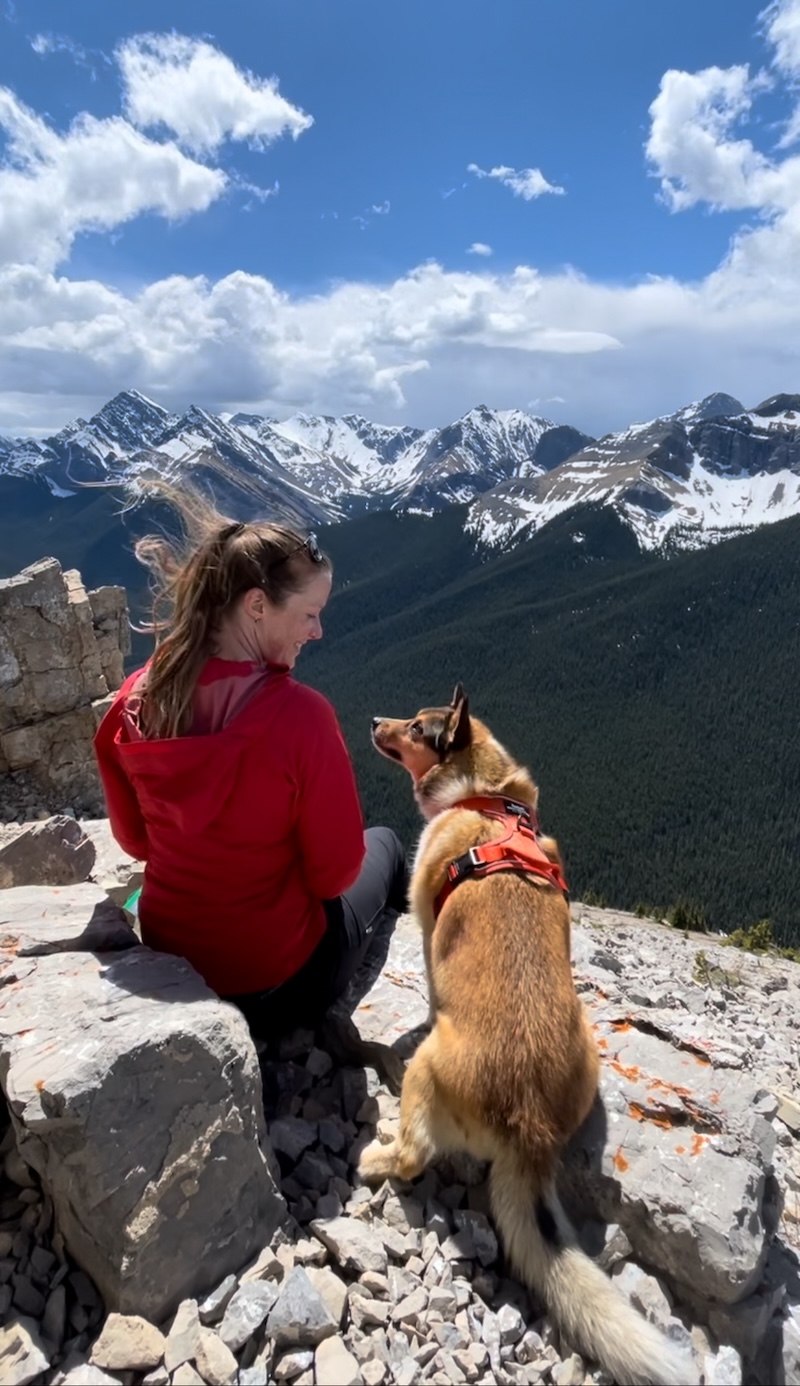
Stephanie with Neirah, a Corgi/Heeler mix, on a summit hike called Sulphur Skyline in Jasper National Park. (Photo credit Lars Bjornstad)
I’ve interviewed several dog trainers over the years about their decision to move away from aversive methods that use force, pressure, corrections to focus on positive reinforcement methods. Some common experiences of the trainers I interviewed include:
- their initial underlying motivation to make the change was based on an emotional connection with a dog;
- knowledgeable instruction and support from skilled positive force-free trainers was important to their success;
- they faced significant negatively from others, including aversive trainers in their local community and online;
- they felt unpleasant emotions as they came to terms with the negative experiences of the dogs they trained previously, but this was off-set by how much better they felt training without aversive methods/tools and how much happier their dogs seemed about training.
I’d also like to point out that not one of the trainers I interviewed said that they were unable to train dogs to the same level of proficiency as previously, and some mentioned that once their new dog training skills were developed, the dogs seemed to learn more quickly. This was glaringly apparent in Sue Ailsby’s experience when she tells of teaching her dog to do the broad jump in a matter of minutes using clicker training, while others in her kennel club had been trying for over a year to teach their dogs to do the broad jump using aversive methods. You can read about Sue Ailsby’s crossover journey “Responding to Change: One Trainer’s Journey From Compulsion to Positive Reinforcement” in the Spring 2022 issue of APDT Chronicle of the Dog, pages 44 – 49.
Most recently, I interviewed Stephanie Rombough, a force-free trainer from Edmonton, Canada. You may have seen her dog training videos on social media. Her instructional videos are clear, concise, and easy to implement, and I have several of her videos bookmarked so I can easily share with dog owners looking for help. Stephanie, like myself, had a parent who was a compulsion-based dog trainer and she learned how to train dogs and was a firm believer that dogs needed to be trained this way. Until she met a very special dog named Burrito. You can read the interview in Stephanie’s blog post
 Certified Professional Dog Training